Startup Checklist 2026: 25 Essential Documents Every Founder Must Have Before Raising Funds, Hiring Employees, or Scaling a Business
Most Startups Fail Before They Even Begin
Every year thousands of entrepreneurs register companies, launch websites, create social media pages, and start selling products.
Yet many of them unknowingly make mistakes that later result in:
• Founder disputes
• Investor rejection
• Tax penalties
• Trademark conflicts
• Employee lawsuits
• Compliance notices
• Funding delays
• Business shutdowns
The truth is simple:
A startup is not just an idea.
A startup is a legally, financially, and operationally structured organization.
If your startup documentation is incomplete, your business may not be ready for funding, partnerships, government schemes, acquisitions, or large-scale growth.
Before spending money on marketing or fundraising, every founder should ensure that the following startup essentials are in place.
SECTION 1: FOUNDERS & OWNERSHIP DOCUMENTS
These documents protect the relationship between founders and prevent future conflicts.
1. Founders Agreement
A Founders Agreement clearly defines:
• Roles and responsibilities
• Ownership percentages
• Decision-making authority
• Capital contribution obligations
• Vesting conditions
• Exit rights
Without this document, disagreements can destroy a startup.
2. Co-Founder Exit Clause
What happens if a founder leaves after six months?
Who owns the shares?
Can the founder start a competing business?
Can the company buy back shares?
These situations should be documented before problems arise.
3. Shareholders Agreement (SHA)
This document governs relationships among shareholders.
It usually covers:
• Voting rights
• Dividend policies
• Transfer of shares
• Investor rights
• Deadlock resolution
• Exit mechanisms
Investors often require this before investing.
4. Capitalization Table (Cap Table)
A Cap Table tracks:
• Founders’ ownership
• Investor ownership
• ESOP allocations
• Future dilution
Every serious startup should maintain an updated cap table from Day One.
SECTION 2: BUSINESS REGISTRATION & LEGAL FOUNDATION
5. Company Incorporation Documents
Depending on business structure:
• Private Limited Company
• LLP
• Partnership
• OPC
Founders should maintain:
• Certificate of Incorporation
• CIN
• PAN
• TAN
• Registered Office Proof
6. Memorandum of Association (MOA)
Defines:
• Company objectives
• Business activities
• Authorized scope of operation
7. Articles of Association (AOA)
Defines:
• Internal governance
• Share issuance procedures
• Board powers
• Voting mechanisms
8. GST Registration
Essential for:
• Input tax credit
• B2B transactions
• Vendor onboarding
• Marketplace registrations
9. Industry-Specific Licenses
Depending on your business:
• FSSAI
• MSME/Udyam
• Import Export Code
• Shop & Establishment
• Professional Tax
• Trade License
• Startup India Recognition
SECTION 3: INTELLECTUAL PROPERTY PROTECTION
Many founders spend years building a brand but never protect it.
10. Trademark Registration
Protect:
• Company name
• Brand name
• Product names
• Logo
• Tagline
11. Copyright Registration
Useful for:
• Content creators
• Software companies
• Educational businesses
• Media startups
12. Patent Documentation
Applicable for:
• Technology startups
• Manufacturing innovations
• Deep-tech products
13. Intellectual Property Assignment Agreement
Ensures that:
The company—not the founder, employee, or freelancer—owns the intellectual property.
This is one of the most overlooked startup documents.
SECTION 4: TEAM & HR DOCUMENTS
Hiring employees without documentation is risky.
14. Offer Letter
Defines:
• Compensation
• Joining date
• Designation
• Probation terms
15. Employment Agreement
Covers:
• Duties
• Confidentiality
• Non-compete clauses
• Termination conditions
16. Employee Handbook
Includes:
• Leave policy
• Work ethics
• Code of conduct
• Grievance mechanism
17. HR Policy Manual
A growing startup should establish:
• Attendance policy
• Remote work policy
• Data security policy
• Anti-harassment policy
18. ESOP Agreement
Helps attract talent by offering ownership incentives.
Investors often expect startups to maintain an ESOP pool.
SECTION 5: BUSINESS OPERATIONS DOCUMENTS
19. Client Agreement
Protects revenue by defining:
• Scope of work
• Deliverables
• Payment terms
• Refund conditions
20. Vendor Agreement
Protects relationships with:
• Suppliers
• Service providers
• Contractors
21. Non-Disclosure Agreement (NDA)
Used when discussing:
• Business ideas
• Technology
• Customer data
• Partnerships
22. Service Agreement
Critical for service-based businesses and agencies.
23. Terms of Service
Every website and digital platform should have one.
24. Privacy Policy
Required when collecting:
• Names
• Emails
• Phone numbers
• Customer information
SECTION 6: FINANCE & COMPLIANCE DOCUMENTS
This is where many startups struggle.
25. Financial Model
Investors want projections.
Your model should include:
• Revenue forecasts
• Expense forecasts
• Cash flow
• Break-even analysis
• Funding requirements
26. Pitch Deck
A strong deck should explain:
• Problem
• Solution
• Market size
• Business model
• Competition
• Traction
• Team
• Funding ask
27. Accounting Records
Maintain:
• Profit & Loss Statements
• Balance Sheets
• Cash Flow Statements
28. GST Records
Maintain:
• GST Returns
• GST Payments
• GST Reconciliation
29. TDS Records
Maintain:
• TDS Deductions
• TDS Returns
• Certificates
30. Invoices & Purchase Records
Every startup should maintain organized documentation.
31. Bank Statements & Financial Audit Trail
Investors often request these documents during due diligence.
SECTION 7: FUNDRAISING READINESS
If you plan to raise funding, prepare:
32. Investment Term Sheet
Defines:
• Valuation
• Equity offered
• Investor rights
• Liquidation preferences
33. Due Diligence Data Room
Maintain a digital folder containing:
• Legal documents
• Compliance documents
• Financial records
• Contracts
• IP documents
34. Investor Reporting Templates
Professional startups prepare regular:
• MIS Reports
• KPI Reports
• Financial Updates
SECTION 8: GOVERNMENT BENEFITS & STARTUP OPPORTUNITIES
Many founders leave money on the table because they never apply for:
• Startup India Benefits
• MSME Benefits
• Mudra Loans
• CGTMSE Schemes
• SIDBI Programs
• State Startup Policies
• Innovation Grants
• Subsidies and Incentives
Is Your Startup Really Ready?
Answer these questions:
✓ Do you have a Founders Agreement?
✓ Is your trademark protected?
✓ Do you maintain a Cap Table?
✓ Are your employee contracts legally compliant?
✓ Is your startup investor-ready?
✓ Do you have a financial model?
✓ Do you have proper compliance documentation?
If your answer is “No” to more than 5 questions, your startup may not be fully prepared for growth, funding, or expansion.
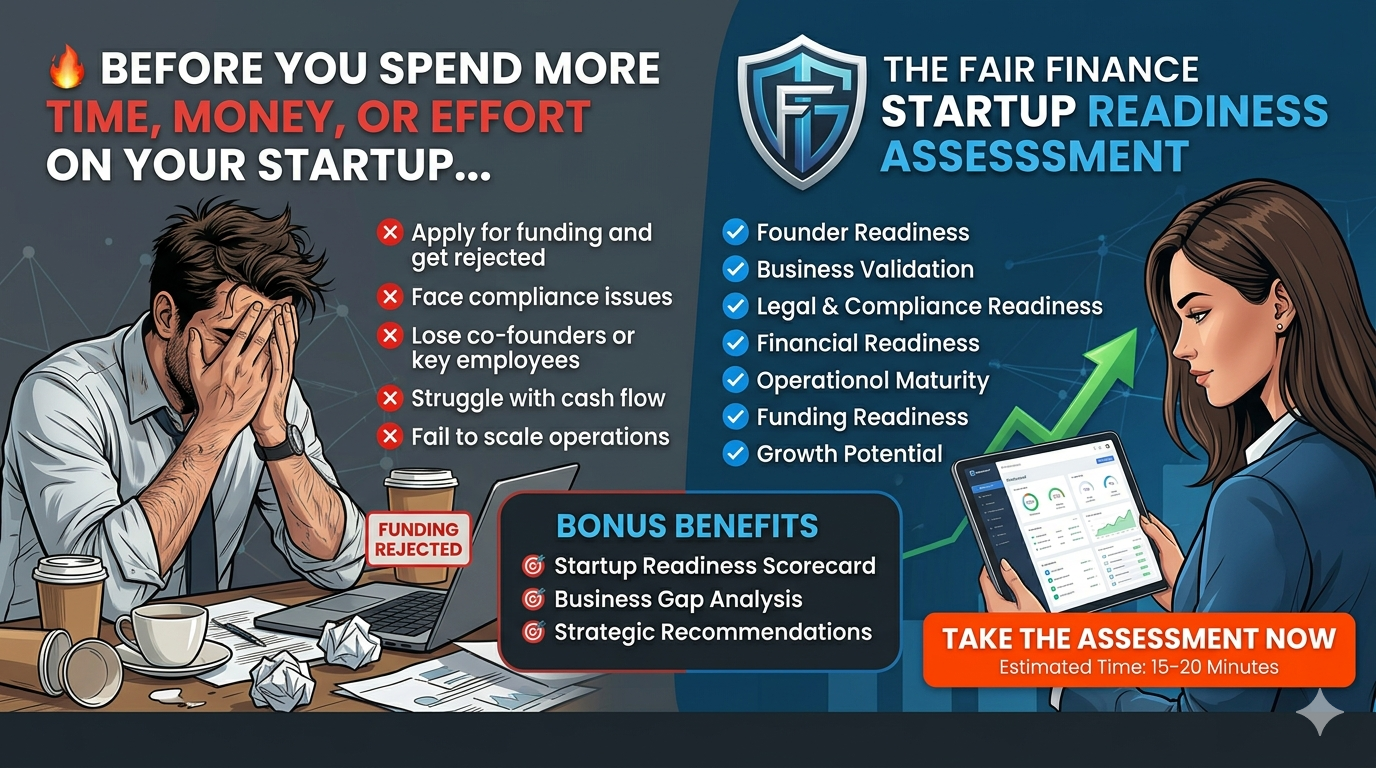
Free Startup Readiness Assessment
At Fair Finance, we help entrepreneurs understand whether their startup is legally, financially, and operationally ready for growth.
Our Startup Readiness Assessment covers:
✓ Legal Documentation Review
✓ Compliance Health Check
✓ Funding Readiness Evaluation
✓ Financial Model Assessment
✓ Founder Structure Review
✓ Investor Preparation Guidance
✓ Government Scheme Eligibility Check
Fill out the Startup Readiness Form and receive an initial assessment from our team.
Whether you are at the idea stage, early revenue stage, or preparing for funding, understanding these fundamentals can save years of mistakes and potentially millions of rupees.
The strongest startups are not built on ideas alone.
They are built on systems, documentation, compliance, and execution.